

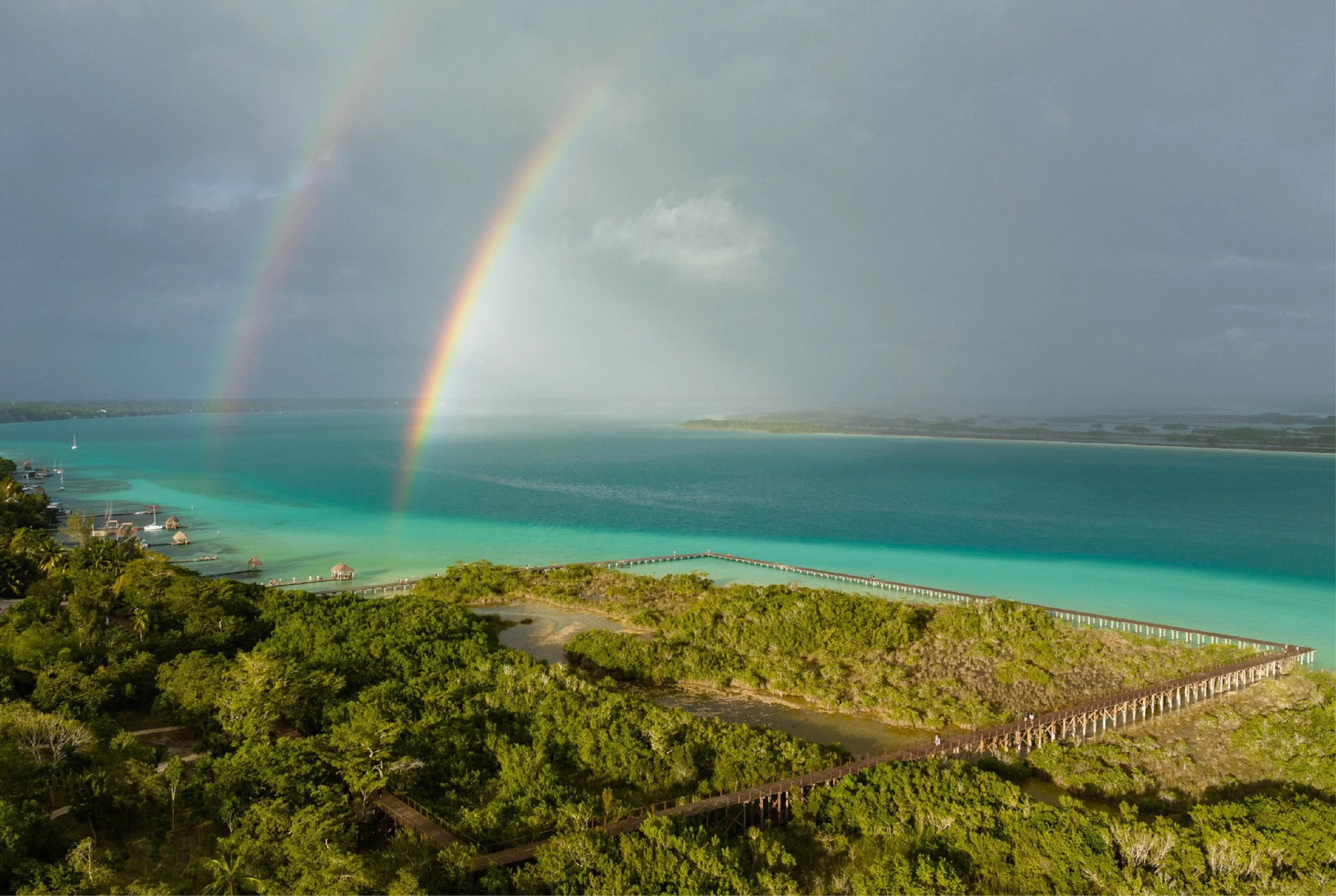
Bacalar real estate investment could soon look very different if the lagoon were ever declared a natural reserve.
Now don’t get me wrong, I’m not saying this is going to happen — or even that it’s in the works. However, I would be remiss if I didn’t at least daydream a bit…
Because if Bacalar — one of Mexico’s most pristine and untouched lagoons — were ever to be declared a Natural Protected Area, the effects on its real-estate market could be nothing short of explosive. Imagine a place where new development halts overnight, creating a truly finite supply of homes, condos, and lake-view lots. For those who already own property? That’s a recipe for exponential appreciation.
What Happens When Land Becomes “Untouchable”
When governments move to protect land — whether through nature-reserve designation, UNESCO World Heritage status, or restricted zoning — the value of existing real estate typically jumps between 50% and 120% over the following years.
Examples include:
- Tulum’s biosphere expansion (2015–2019): lake-adjacent properties saw a 70%+ increase in land value.
- Costa Rica’s Nicoya Peninsula: after environmental zoning tightened, price per m² in Santa Teresa nearly tripled in 5 years.
- Hawaii’s Kauai island: strict preservation policies led to some of the highest property premiums in the Pacific — demand went up, supply froze.
Bacalar Real Estate Investment: Hypothetical Price Projection
Let’s take today’s average Bacalar lake-view rate of ~$2,500 USD/m² and apply a conservative scenario modeled after Tulum and Nicoya trends:
| Scenario | Annual Appreciation | 5-Year Projection | Est. Price/m² |
| Conservative | +12% YoY | +76% | $4,400/m² |
| Moderate | +15% YoY | +100% | $5,000/m² |
| Aggressive | +18% YoY | +127% | $5,675/m² |
Under any of these models, a $250,000 USD 2-bed/2-bath unit today could be worth $460,000 – $475,000 USD within five years.
The ROI Ripple Effect — How Bacalar Real Estate Investment Benefits from Scarcity
For anyone exploring Bacalar real estate investment, this “nature reserve” scenario could completely reshape expected returns. Now let’s dig a little deeper into what this means for returns, because appreciation is only half the story.
When supply freezes but tourism continues to climb, rental performance metrics explode. In markets where development restrictions have tightened (like parts of Tulum, Nosara, and Kauai), owners have seen:
- Average Daily Rates (ADR) climb 25–40% within 2 years.
- Occupancy rates rise from 68–75% to 82–90% due to limited inventory.
- ROI acceleration of 4–6 percentage points, pushing annual returns from 8–10% up to 12–16%.
If Bacalar followed even the conservative version of that pattern, here’s what we could see:
| Scenario | ADR Growth | Occupancy | Gross ROI Range | Est. Annual Net ROI |
| Conservative | +20% | 80% | 10–12% | ~9% |
| Moderate | +30% | 85% | 12–14% | ~11% |
| Aggressive | +40% | 90% | 15–18% | ~13-14% |
That means a $250,000 unit generating $25K/year today could climb to $35K–$45K+ in annual income within 3–5 years — without any new competition entering the market.
With limited room for new hotel and Airbnb inventory, even small shifts in tourism demand could create outsized jumps in profitability. This is the same dynamic that pushed certain areas of Sayulita and Nosara from 8% to 18% average ROI once local construction slowed.
In short:
📈 Appreciation builds wealth.
💸 Rental performance builds cash flow.
🏝️ And when both accelerate together — it’s lightning in a bottle.
Why This Would Be a “No New Supply” Market
If Bacalar were to receive nature-reserve status, developers would face:
- Zero new construction permits near the lagoon.
- Strict environmental MIA approvals (if any).
- A cap on commercial activity and lodging density.
That means current inventory instantly becomes rare and irreplaceable — similar to owning a beachfront home in Malibu or inside Tulum’s Aldea Zama Phase 1 after permits closed.
🏗️ What This Means for Bacalar Real Estate Investors
If you already own in Bacalar, this scenario would create the perfect storm of scarcity and demand.
Tourism — especially from eco-conscious travelers — would keep rising, while new development slows or disappears. The result? Higher nightly rates, stronger resale values, and accelerated long-term equity growth.
For a real-world example of how global recognition is already reshaping Bacalar’s image, read our article Michelin Keys in Bacalar: The Wellness Wave Is Official. It highlights how eco-luxury hospitality and wellness travel are fueling the next phase of Bacalar’s growth.
A Little Real Talk
Now, is this my way of casually encouraging you to pull the trigger on a property in Bacalar?
Short answer: yes.
Long answer: still yes — but hear me out.
I have over 15 years of experience navigating markets just like this — places on the edge of discovery that suddenly explode with growth once the world catches on. I’ve seen it happen time and time again. I’ve also seen countless people hesitate — in Playa del Carmen, in Tulum — only to circle back a few years later wishing they’d acted sooner.
I know the hesitation, but I also know the potential. And Bacalar, right now, is sitting in that exact pre-boom window I’ve seen before. The kind that only comes once per market cycle.
The Dream Isn’t So Far-Fetched
Even though the governor clarified there’s no official proposal, this discussion alone shows Bacalar’s rising environmental and economic importance. The world is waking up to its lagoon’s beauty — and that’s exactly how every “next-big-thing” story begins.
So yeah… maybe this is just a daydream. But then again, so was Tulum in 2008. In the end, Bacalar real estate investment is about timing. If supply locks while demand keeps rising, early investors will see unmatched appreciation.
— Investor & Developer Ryan Gravel